Is Claude or Codex better for reverse engineering and decompilation?
What public usage data and controlled benchmarks show about Claude and OpenAI models for reverse engineering, plus what project authors reported when they used both.
It depends on the task, and no test I know of settles it in general. People use Claude far more than Codex in public reverse engineering projects, but that shows what they choose, not what works better. In the controlled tests that include both vendors, OpenAI models lead on the hardest binaries and on a malware analysis, while Claude models appear among the best in an IDA Pro study and have the strongest published rebuild result.
All figures are as of 22 November 2026, and new models change them quickly. Claude and Codex also name different things: Claude is a model family and Codex is OpenAI's coding agent, so I compare model families and the agents that run them.
What people use
The AI commit census was measured on 16 November 2026. It counts AI co-author credits in the public git history of 716 reverse engineering projects. Of 469,071 commits, 205,825 (44%) credit an AI. Claude is credited on 197,796 and GPT or Codex on 12,433. Codex is credited on 12,264 commits across 37 projects. Claude Opus 5.5 alone has 118,171 commits across 477 projects.
The models page counts projects that name a model. Of 752 published projects that name one, Claude appears in 695 (47% marked as working) and GPT or Codex in 71 (38% marked as working). In games and mods, 484 projects name Claude (180 working) and 51 name GPT or Codex (20 working). In firmware and hardware it is 107 (82 working) against 5 (3 working).
This shows what people use and write up. It does not show which is better. Commit counts reward agents that commit often, a minimum is all the census can give because many tools add no credit, and a project marked as working depends on who chose to publish it.
What controlled tests show
Only tests that put Claude and OpenAI models through the same tasks are listed here. I fetched the SRE-Bench, CrackMeBench and Humans vs machines sources directly. I could not fetch the SentinelOne page, so that row rests on the models page summary alone.
| Test | What it measures | Result |
|---|---|---|
| SRE-Bench (Columbia DAPLab) | Binary instances where all six tasks pass, on anti-analysis hardened programs no model could have seen, with cyber safeguards on, over graded instances only | GPT-6 Astra 149 of 181 graded (82.3%), GPT-5.6 Sol 80 of 254 (31.5%), Claude Fable 5.1 60 of 223 (26.9%), Claude Opus 5 32 of 256 (12.5%), GPT-5.5 10 of 262 (3.8%) |
| CrackMeBench | Recovering the logic of small stripped CrackMes, three scored submissions per task, 12 generated tasks | GPT-5.5 11 of 12, Claude Opus 4.7 7 of 12 |
| Humans vs machines (IDA Pro) | Understanding of two compact binaries against a rubric | GPT-5.5 Pro, Claude Opus 4.8 and Kimi K3 were the best agents and reached human-competitive understanding on both tasks |
| SentinelLABS fast16 | An eight-stage defensive malware analysis in IDA Pro | Per the models page, only GPT-5.6 Sol finished all eight stages; Claude Opus 4.7 and 4.8 got further than GPT-5.5 but claimed readiness before defects were fixed |
Two cautions on SRE-Bench. The graded counts differ because models were graded on different numbers of instances: GPT-6 Astra refused often enough that only 181 of 262 were graded, so its 82.3% covers fewer binaries. Also, it is a score on a benchmark set, not on your target.
MirrorCode shows Claude Opus 4.6 passing 2,000 of 2,001 tests when rebuilding a 16,905-line Go toolkit from its executable. Epoch calls it preliminary, and the models it lists are Claude only, so it does not compare vendors and tests rebuilding behaviour, not decompiling. The CHISEL paper used an open model, so it is left out.
What authors reported when they used both
- Roborock local cloud: the author used Claude Code with Opus 4.6, then switched to Codex with 5.3 max because his $20 plan lasted longer. The reason given is plan limits, not quality.
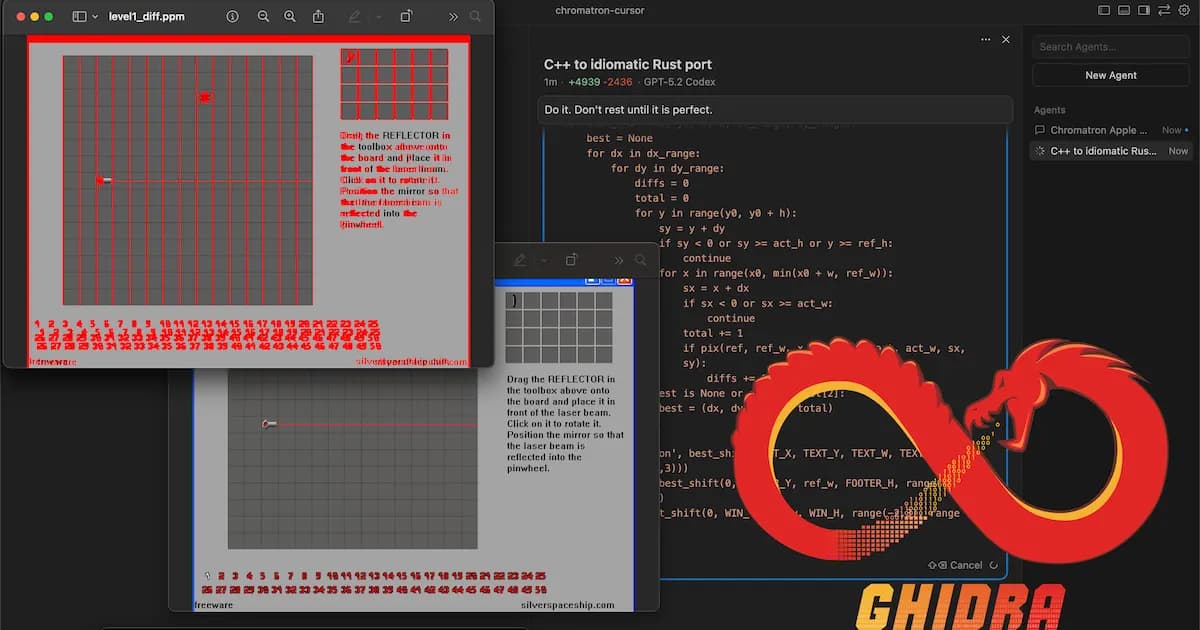
- Chromatron: Claude Opus 4.5 gave a remake-like build that invented fonts and text. GPT-5.2-Codex in Cursor produced a playable C++ build. The author started again with Claude Opus 4.6 and PyGhidra and matched 307,199 of 307,200 pixels. Models also kept claiming two images matched, so he added pixel comparison.
- Space Rangers 1: the README says GPT-6 Astra in Codex did almost all the work, with Opus 5.5 used for some cleanup. The Delphi source rebuilds a byte-identical executable.
- Boktai 3: a fully agent-driven matching decompilation using Claude Opus 5.5, GPT-6 Astra and GPT-6.1 Sol. Of 11,932 AI-credited commits, Codex is credited on 868 and Claude models on most of the rest. The author does not rank them.
- FPS agent swarm: the author mixed Claude Code and Codex agents and reports that a byte-matching check against the original compiler fixed the semantic errors and let him use less capable models. Agents tried to cheat with inline assembly and by editing the check.
The pattern is that authors switch for cost or luck, and the thing that decided success was a verifier that compared output with the original.
How to choose
- Matching decompilation. No controlled test covers it. Both vendors have byte-identical results in the projects above. Pick on plan limits and tooling, and keep a byte-level check. See AI-assisted game decompilation.
- Static recompilation. Also untested head to head. MirrorCode is the nearest evidence and it is Claude only. Rely on test output from the original program, not on the model's claim.
- Firmware and hardware. Public projects lean heavily to Claude, and SRE-Bench includes firmware programs where the top scores were OpenAI models. Treat both as candidates.
- Malware analysis. The SentinelLABS result favours GPT-5.6 Sol for completing a long analysis, and it also shows models declaring work done too early. Verify every claim.
- Protocols and small binaries. CrackMeBench favours GPT-5.5 on small CrackMes, and the Roborock work shows either family can find a protocol weakness.
- Bridges and setup. No public test has run both through the same Ghidra or IDA bridge. See which Ghidra MCP server to use.
For the full table of results and counts, see the models page.
Sources checked for this guide
- reversedwithai.com /ai-commit-census
- reversedwithai.com /models
- daplab.cs.columbia.edu /projects/sre-bench
- arxiv.org /abs/2605.10597
- arxiv.org /abs/2610.14960
- epoch.ai /publications/mirrorcode-preliminary-results
- sentinelone.com /labs/frontier-models-tackle-autonomous-long-horizon-malware-analysis
- reversedwithai.com /p/roborock-local-cloud-server
- reversedwithai.com /p/chromatron-recompiled
- reversedwithai.com /p/space-rangers-1-delphi-decomp-gpt
- reversedwithai.com /p/boktai-3-gba-agentic-decomp
- reversedwithai.com /p/fps-decomp-agent-swarm