What was done
After attempts with Claude Opus 4.5 and GPT-5.2-Codex, Claude Opus 4.6 and PyGhidra rebuilt Chromatron in Rust so it runs natively on Apple Silicon, Windows, Linux and in a browser.
Piotr Migdał of Quesma rebuilt Chromatron, Sean Barrett's 20-year-old laser and mirror puzzle game, from its Windows XP and PowerPC binaries. After attempts with Claude Opus 4.5 and GPT-5.2-Codex, Migdał started fresh with Claude Opus 4.6 and PyGhidra and produced a Rust version for Apple Silicon, Windows, Linux and the web that matches the original almost pixel for pixel.
How it was done
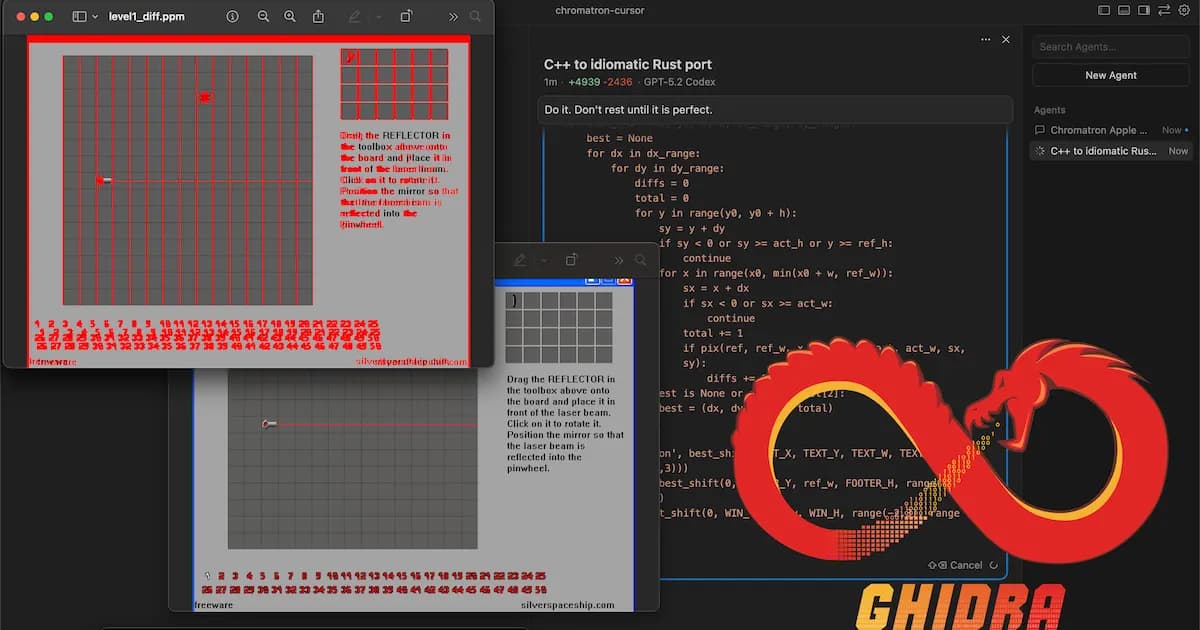
Migdał tried four routes. Claude Code with Opus 4.5 and GhidrAssistMCP gave a C and Raylib version that looked like a remake, and the model often invented fonts and text. An m2c route with Opus 4.5 got positions right but struggled with assets, so Migdał dropped it. Cursor with GPT-5.2-Codex, which ended up using Ghidra's headless mode after an MCP misconfiguration, produced a playable C++ and SDL2 build. Migdał added pixelwise screenshot comparison because models kept claiming two images were the same. The final run used Opus 4.6 with PyGhidra and Rust. The model worked mainly from the Win32 binary and used the Mac PPC one for cross-reference. Rendering moved from SDL2 to winit and softbuffer, which made the Wasm build simple. Most of the time went on the font. Models suggested Geneva and MS Sans Serif, but a small comparison tool showed it was VGASYS, the Windows default system font.
Results
307,199 of 307,200 pixels match the original. The one remaining pixel comes from the draw order of the laser beam and the grid overlay. The game binary is 40 kB compressed and 96 kB unpacked. A playable web version saves progress automatically.
Discussion
Sources
Sources reviewed · Added
An AI model drafted this entry from the sources above. Checked against the sources on 13 Oct 2026. The figures are the author's. How entries are checked. Something wrong? Tell me.