What was done
Agents get only an educational CrackMe executable and a sandbox of RE tools. On the 12 generated tasks GPT-5.5 solved 11, Claude Opus 4.7 solved 7 and Kimi K2 solved 5 (pass@3).
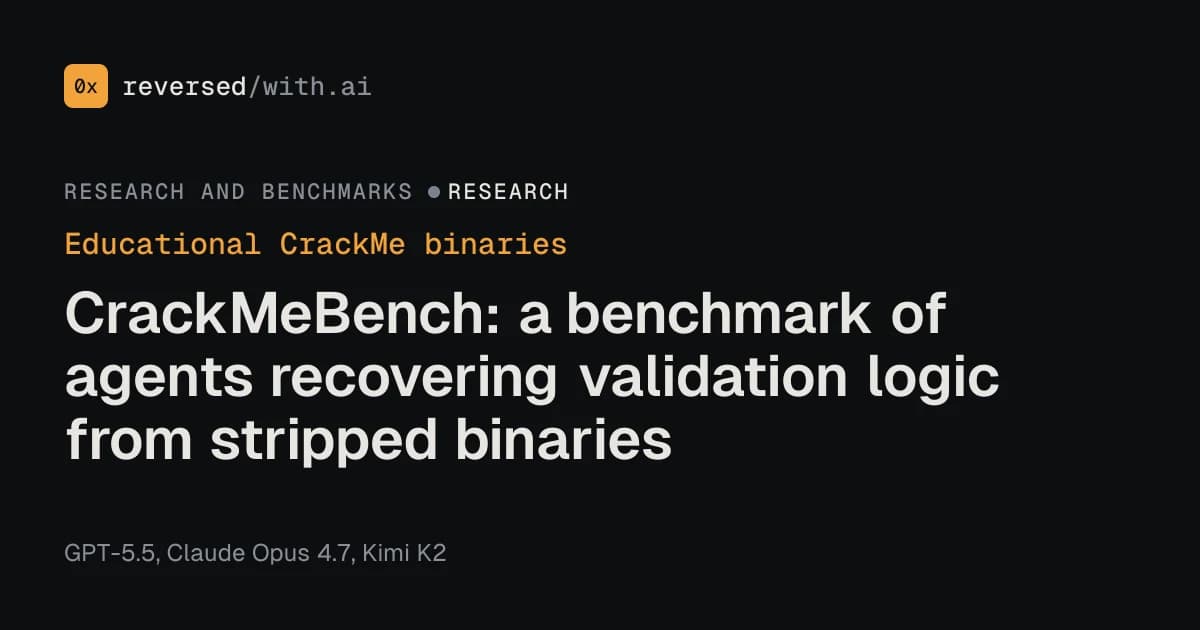
CrackMeBench, by Isaac David and Arthur Gervais, is a benchmark that tests whether language-model agents can recover validation logic from stripped educational CrackMe binaries and submit an input, serial or key generator the program accepts. On the 12 generated tasks, GPT-5.5 solved 11, Claude Opus 4.7 solved 7 and Kimi K2 solved 5 (pass@3).
How it was done
The v0 benchmark combines eight public calibration CrackMes with twelve generated main-score tasks built from seeded C, Rust and Go templates. Agents get only the executable and a shell in a no-network Linux Docker sandbox with standard tools: file, strings, readelf and objdump, radare2 and headless Ghidra wrappers, gdb, strace, ltrace and qemu, and Python packages such as angr, Z3 and capstone. Each task has a deterministic executable oracle, and submissions are scored externally rather than judged from free-form explanations. The evaluation used a five-minute budget and three scored submissions per task.
Results
On the generated split, pass@3 was 11/12 (92%) for GPT-5.5, 7/12 (58%) for Claude Opus 4.7 and 5/12 (42%) for Kimi K2. The harder half separated the models more: 5/6, 2/6 and 1/6. On the eight public calibration tasks, pass@3 was 3/8, 2/8 and 1/8. The benchmark records pass@1 and pass@3, wall-clock time, command traces, tool categories, token usage, estimated cost and qualitative failure labels. The authors limit the scope to educational, purpose-built programs, and note that it may understate workflows that depend on interactive Ghidra use or long-lived analyst state.
Discussion
Sources
Sources reviewed · Added
An AI model drafted this entry from the sources above. Checked against the sources on 14 Oct 2026. The figures are the author's. How entries are checked. Something wrong? Tell me.