What was done
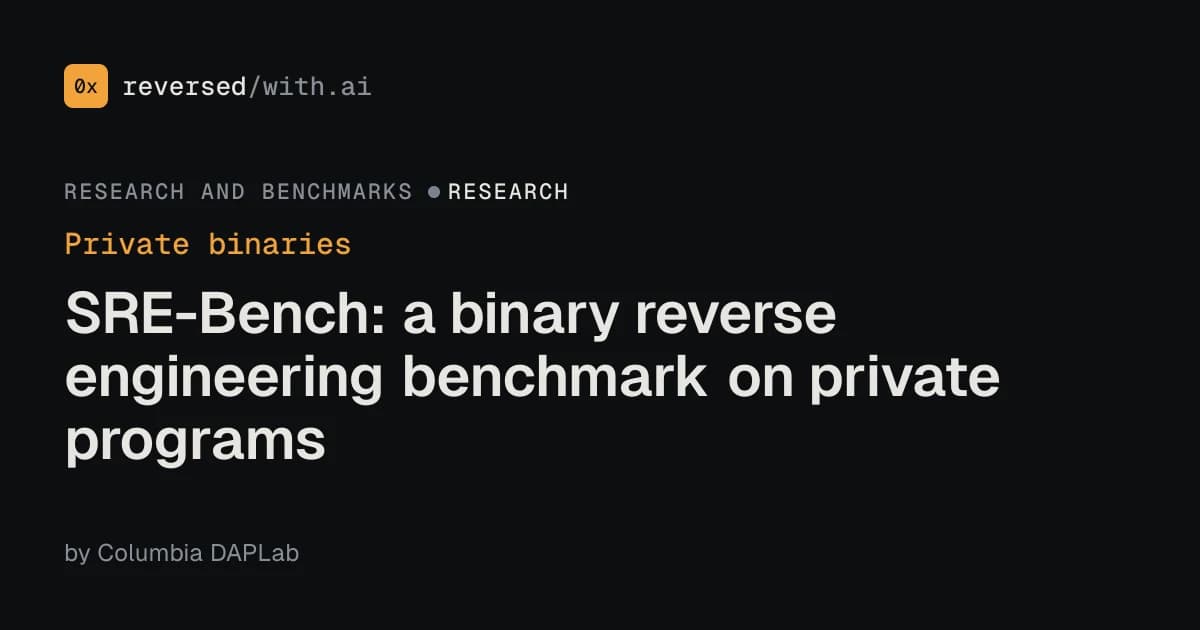
Columbia's DAPLab built a benchmark from programs models can't have seen, to measure real reversing ability.
SRE-Bench is a binary reverse engineering benchmark from Columbia's DAPLab, built with Vals AI and UC Berkeley. It uses private programs that no model could have seen during training. Of eight models tested with their cyber safeguards on, GPT-6 Astra fully solved 82.3% of the binary instances it was graded on, but it refused often enough on safety grounds that only 181 of the 262 were graded. The next best, GPT-5.6 Sol and Claude Fable 5.1, fully solved 31.5% and 26.9%.
The authors argue that most benchmarks leak: if a binary was built from public source, a model can recognise the program instead of analysing it. Some benchmarks also fall far short of real targets in size and anti-analysis hardening. To fix both, reverse engineering experts spent over 5,000 hours writing 19 private programs that average 16,900 lines of code. They then added 44 in-house anti-analysis primitives. The result is 262 binary instances and 1,572 tasks with deterministic grading, spread across six difficulty levels.
The task is far from solved for most agents: the weakest of the eight, GLM-5.2, solved none, and the authors note that success with source code does not carry over to binaries. Agents also failed differently from humans. They were oddly insensitive to compiler optimisation levels and static linking, which the authors read as pattern matching rather than semantic reasoning.
The leaderboard is live at vals.ai. The paper is "The Next Challenge for Agentic Cybersecurity: A Realistic, Contamination-Free Reverse Engineering Benchmark" (arXiv, 2026). Contributors include Jeremy Spence, Nicholas Assaderaghi, Jinhao Zhu, Nikil Ravi, Raluca Ada Popa, Guannan Wei, Yangruibo Ding and Zhuo Zhang.
Discussion
Sources
Sources reviewed · Added
An AI model drafted this entry from the sources above. Checked against the sources on 13 Oct 2026. The figures are the author's. How entries are checked. Something wrong? Tell me.