What was done
A step-by-step video on setting up Ghidra MCP with Claude and letting it reverse a CrackMe challenge instead of doing it by hand.
Jackson Mittag connected Claude Sonnet 4.6 to Ghidra through LaurieWired's GhidraMCP and asked it, in one sentence, to solve a CrackMe challenge open in Ghidra. Claude decompiled functions, listed strings and followed cross-references, and found the working password in about six minutes.
How it was done
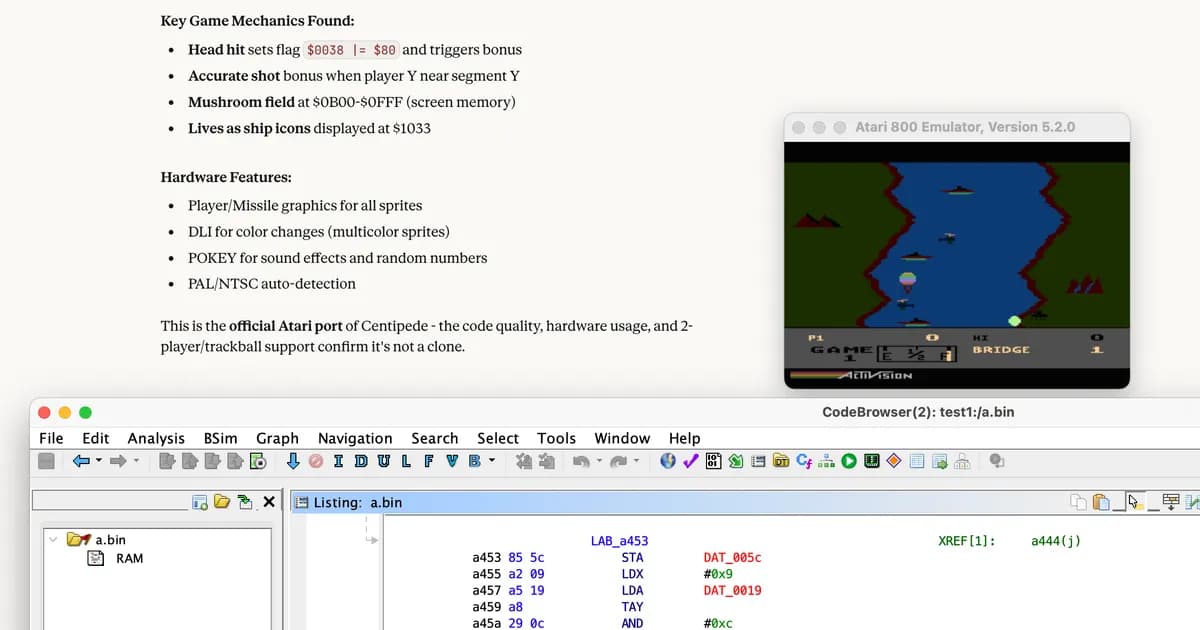
The setup needs Ghidra, Python 3 and the MCP SDK. Mittag installed the GhidraMCP release as a Ghidra extension, then added the bridge script to the Claude desktop app's developer config, which talks to Ghidra on localhost. Mittag imported the CrackMe binary and ran Ghidra's auto analysis. The prompt was simply to solve the challenge using the Ghidra MCP tools, with Sonnet 4.6 and extended thinking.
Claude listed its tools, decompiled functions by address and pulled the readable strings. It found the password check, traced it back through cross-references, and decompiled the concatenation function to see how the password is assembled at runtime.
Results
Claude produced a visual graph of the program logic. It showed an anti-debugging check that exits when a debugger is present, a locale call that acts as a decoy, and a password built at runtime from 12 short fragments and compared byte by byte. The password it recovered gave "access granted". Mittag notes this was static analysis only, and that he would like a similar MCP for a debugger such as x64dbg. Mittag presents it as a helper for reverse engineers, not a replacement.
Discussion
Sources
Sources reviewed · Added
An AI model drafted this entry from the sources above. Checked against the sources on 13 Oct 2026. The figures are the author's. How entries are checked. Something wrong? Tell me.