Who did what
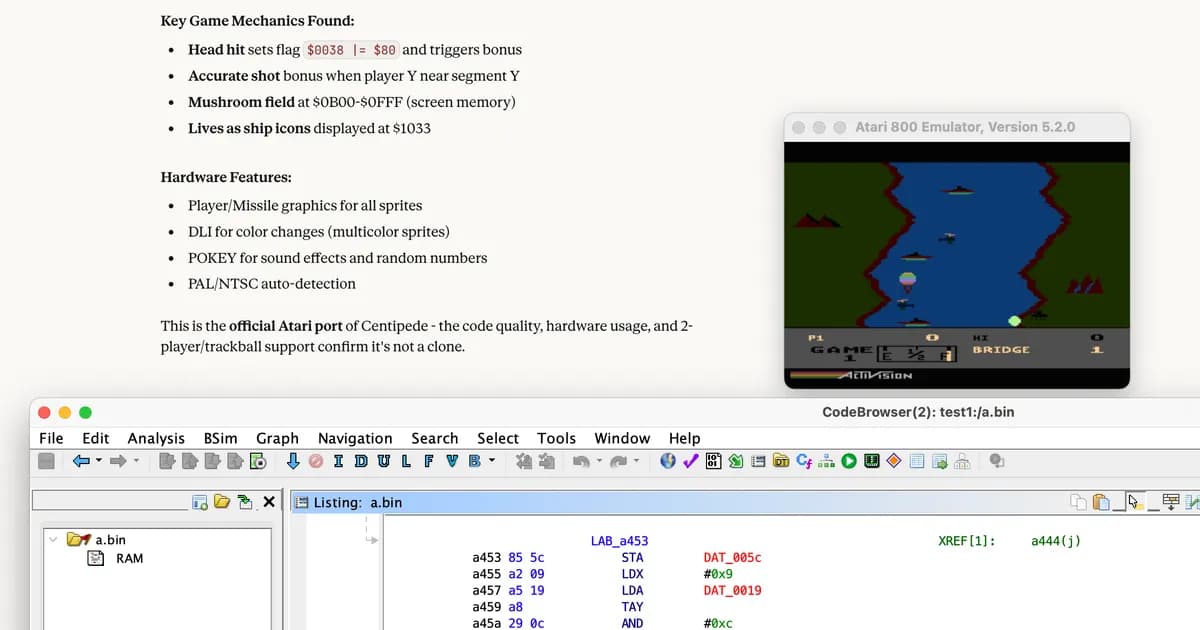
Claude spotted that the ROM was loaded at the wrong address but couldn't rebase it through the MCP tools, so the author did that and applied the patch by hand. Claude also guessed the game was Centipede.
What was done
Through GhidraMCP, Claude found the lives-decrement code in an 8 kB 6502 ROM and the byte to patch; the patched game kept its lives in an emulator.
Rafał Strzaliński used Claude with LaurieWired's GhidraMCP server to find the lives counter in River Raid for the Atari 8-bit, an 8 kB 6502 ROM. Claude located the code that decrements lives, and replacing one DEY instruction with a NOP gave the game unlimited lives in an emulator.
How it was done
The author renamed the binary to a.rom and imported it into Ghidra as plain 6502 code with no platform selected, so Claude had no hint about the game. Claude first asked for the file's MD5 hash to look up known ROMs, but the MCP tools could not compute one. Ghidra had loaded the ROM at $0000 instead of $A000, which broke cross-references. Claude diagnosed this but could not rebase the program through the MCP tools, so the author rebased it by hand (a first attempt at $8000 was also wrong).
From the hardware register addresses, Claude worked out that the platform was the Atari 8-bit. It then found the load, decrement and store sequence for the lives counter. Because the MCP tools could not write the binary, the author applied the patch with dd, changing $88 (DEY) to $EA (NOP) at offset 0x355.
Results
The patch worked: in an emulator, crashing into a bridge left the lives counter at 3. Claude was weaker on wider context: it confidently guessed the game was Centipede, and struggled with tasks such as identifying sprite data. Some tool calls took around 30 seconds each, which the author found too slow for interactive work. Setting up the chain of Claude, MCP server, Ghidra extension and Ghidra also took manual effort.
Discussion
Sources
Sources reviewed · Added
An AI model drafted this entry from the sources above. Checked against the sources on 13 Oct 2026. The figures are the author's. How entries are checked. Something wrong? Tell me.