Who did what
Reports had wrong IoCs, file relationships and persistence locations even after verification passes; verdicts flip-flopped and leaned on VirusTotal. One generated script printed a hallucinated URL instead of extracting it. The author concludes verdicts still need an experienced analyst.
What was done
A G DATA researcher ran GPT 5.1, GPT 5.1-mini, Claude Sonnet 4.6 and Opus on real samples in an isolated lab. A decryption script that took six hours by hand took 30 minutes plus an hour of checking.
Karsten Hahn of G DATA built an isolated lab to test whether LLMs can analyse malware reliably. GPT 5.1 and Claude Sonnet 4.6 each wrote a working decryption script in 30 minutes for a sample that had taken him about six hours by hand. His tests also found frequent factual errors in the models' reports, and he concludes that LLM verdicts cannot be trusted.
How it was done
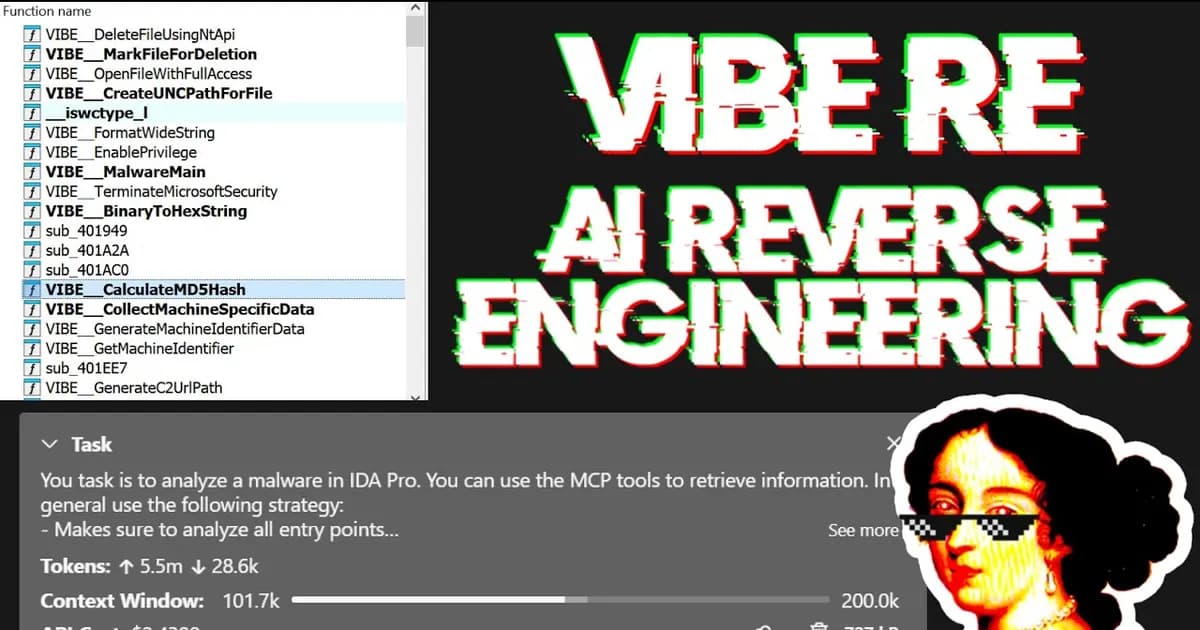
The lab runs on a 12-year-old laptop with 16 GB of RAM: a REMnux VM with Claude and OpenCode, and an isolated Windows 10 VM for dynamic work. MCP servers covered REMnux, REMnux docs, x64dbg, VirusTotal, SSH and Ghidra. He first compared GPT 5.1, GPT 5.1-mini and Claude Sonnet 4.6, then continued with Sonnet 4.6 and Opus.
On an Office document using the CVE-2017-11882 equation editor exploit, GPT 5.1-mini called the file clean and flagged the oletools domain as suspicious. GPT 5.1 and Sonnet both needed steering towards emulating the shellcode with Speakeasy before they printed the next-stage URL. He then wrote a report skill that lists verification steps for every claim, and added verification passes for IPs, hashes, paths and registry keys.
Results
Even with five verification passes, reports had errors in IoCs, file relationships and persistence locations. Verdicts changed during conversations and leaned on VirusTotal. The headless Ghidra MCP improved analysis; the x64dbg MCP was token hungry. The LLM found a debug path in one file of a 10,000-file application he had missed a year earlier. His advice is to have the model write extractors and unpackers, which can be run and checked, rather than trusting written reports. One analysis can cost 5 to 20 euros in API tokens.
Discussion
Sources
Sources reviewed · Added
An AI model drafted this entry from the sources above. Checked against the sources on 14 Oct 2026. The figures are the author's. How entries are checked. Something wrong? Tell me.