Who did what
Claude stalled twice and didn't recognise it was stuck; a researcher redirected it each time. Bishop Fox sums it up as trusting the skill but not yet the judgement.
What was done
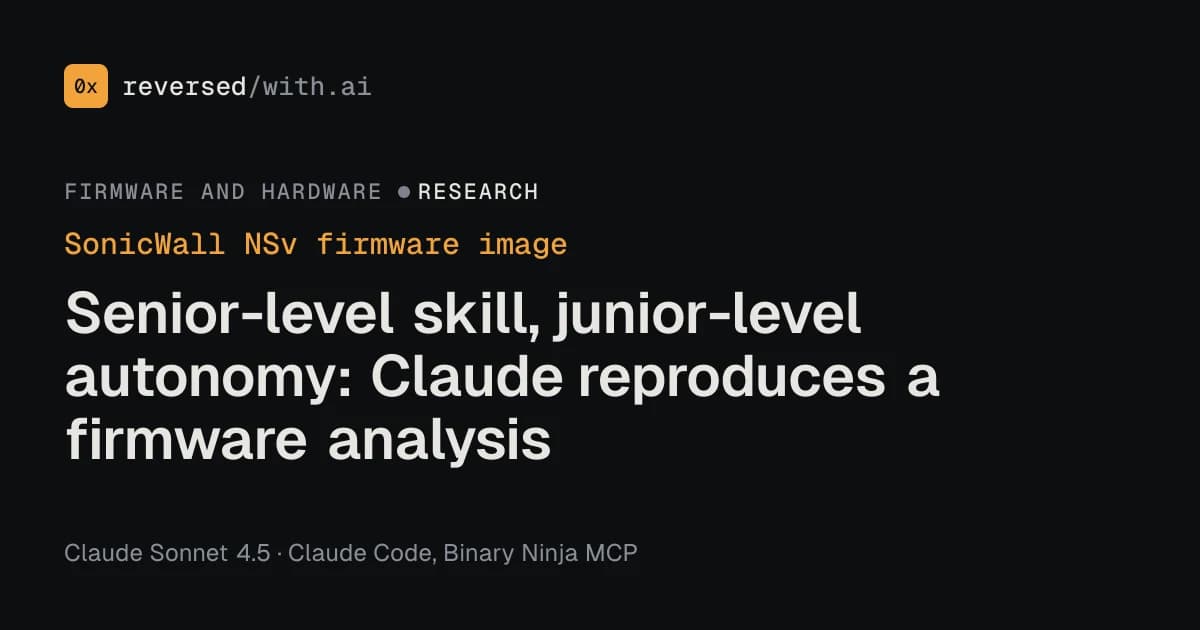
Bishop Fox gave Claude Code an encrypted appliance image and had it repeat research a senior engineer had done by hand; it succeeded with two nudges.
Bishop Fox gave Claude Code, running Sonnet 4.5, an encrypted firmware image from a SonicWall virtual appliance and told it to decrypt it. The model worked out the proprietary format and recovered the decryption key mostly on its own, repeating research a senior engineer had already done by hand. It needed two human nudges.
How it was done
The team drove Binary Ninja through its MCP integration inside Claude Code. Claude got two inputs: the encrypted image and a decrypted root filesystem copied from a different, running version of the appliance. It had no documentation and no hints about the format. Claude read the container structure, then traced the decryption logic in a decompiled binary and found that the key was held by a key-management component shipped on the appliance. When reverse engineering that component by hand kept failing, the team suggested running the appliance's own copy instead. A later question about a cryptographic padding setting was the second nudge.
Results
Claude decrypted the image. Bishop Fox is clear about the limits: it was a reproduction of a problem with a known answer, and the extra filesystem helped. Their conclusion is that the model had senior-level skill but junior-level judgement, and needed a human to say when to change approach. The post does not give a total time.
Discussion
Sources
Sources reviewed · Added
An AI model drafted this entry from the sources above. Checked against the sources on 13 Oct 2026. The figures are the author's. How entries are checked. Something wrong? Tell me.