Evidence at a glance
Based on the linked sources. The author's reported result and independent confirmation are separate checks.
- AI involvement
- Reported models: Claude Opus 5.5. Tools not reported. The writeup below describes the work attributed to AI.
- Reported result
- Works. This is the directory's source-based outcome classification.
- Independent confirmation
- Not reported.
- Human work and limitations
- The project uses a non-persistent loading method, ensuring the original factory firmware remains intact after a power cycle. Development history indicates active collaboration with AI models for testing and code refinement.
Original sources
What was done
This project provides an open-source firmware replacement for the Siglent SDS1000CML+ oscilloscope, enabling advanced protocol analysis, deep-memory capture, and a web-based interface without permanently modifying the device's factory firmware.
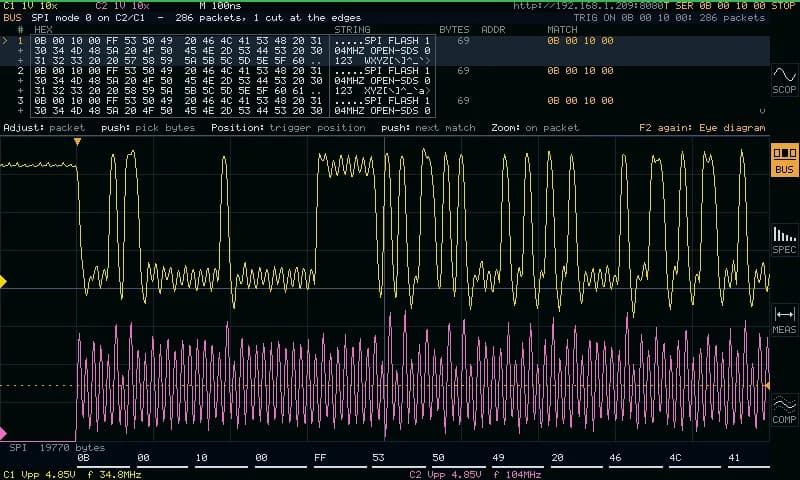
The open-sds1000cml project is an open-source firmware replacement for the Siglent SDS1000CML+ two-channel oscilloscope. It replaces the application running on the device's ARM processor and the associated FPGA images. The firmware enables deep-memory protocol analysis, supporting 500 MS/s sampling on both channels simultaneously with a 1 M-sample record length. It includes hardware triggers for 52 serial protocols, continuous decoding, and a web-based interface accessible via port 8080. The README documents that the firmware does not permanently flash the device; a power cycle restores the factory firmware. The author reports that the project was developed on the SDS1102CML+ model. Recent development commits credit Claude Opus 5.5 as a co-author for various tasks, including browser testing, API hostile testing, and buffer-reuse optimization. Users are warned that the firmware takes control of a mains-powered instrument and should be used at their own risk.